Showing posts with label 5 stars. Show all posts

Friday, October 21, 2016

A New Dawn by John Jackson Miller

A New Dawn was the first novel written to be part of the new Star Wars canon, with input from the Lucasfilm Story Group. Its title serves as a nod to the new beginning that the franchise is embarking on, as well as a twist to the familiar title A New Hope. Primarily it is the story of Kanan Jarrus and Hera Syndulla from the TV series Star Wars: Rebels, taking place six years before that show and showing how they met.

This book takes place on and around the Inner Rim planet of Gorse and its habitable moon, Cynda. As a tidal-locked planet, Gorse has one half continually facing the sun and inhospitably hot, the other side covered in cities that experience perpetual humid night. Kanan, a former Jedi who was born with the name Caleb Dume, is now working as a freight pilot in a mining company called Moonglow. Kanan catches a Clone Wars veteran named Skelly in the act of setting a sabotage explosion, with the goal of sending a message to the Empire about the dangers of the operation. The Empire has been gathering an important mineral called thorillide and tasks the cyborg Count Vidian with increasing the speed of production.

Hera, discontented with the Empire's ruthless actions, has come to the Gorse system to find a friend of hers, a Sullustan named Kaluna who assists the Empire with surveillance. Until saving people from Skelly's sabotage, Kanan had been very careful to conceal his Force-assisted abilities ever since the Emperor issued Order 66. Hera, Kanan, Kaluna, and Skelly cross paths, and once they figure out Vidian's nefarious, self-serving plan for the mining planet and moon, they make every attempt to thwart him. Captain Rae Sloane is also introduced in this story, an Imperial officer given temporary control of the Star Destroyer Ultimatum who doesn't exactly help the rebels, but has the common goal of stopping Vidian.

I enjoyed this book for its strong characters, snappy dialogue, and exciting action. That is to say, everything a Star Wars story ideally should have. I really appreciated how streamlined the book was; Miller doesn't try to shoehorn in extraneous characters or needless subplots. Fans of "Rebels" will get a look at Kanan's backstory, but precious little is revealed about Hera besides what her actions in the book say about her. It is hinted that the two share a mutual attraction, but there's not much time for love when the fate of a whole moon is at stake. What we do see is how well they work together and we come to understand why they mutually decided that Kanan should stay aboard Hera's ship the Ghost. I would like to see another story of how they first encountered Sabine and Zeb before the crew finds themselves on Lothal, but maybe this is being saved for future episodes of the show to explore.

For much more about this book and information about how it was written, directly from the author, check out this page. Caution, spoilers aplenty.

Friday, September 16, 2016

One More Thing: Stories and Other Stories by B. J. Novak

One More Thing is a collection of short stories by that guy who played Ryan on The Office. At least that's how some of you will know him. He also wrote fifteen episodes of the show and this book proves that he's just as funny and insightful a writer on the page as he is for the screen.

All of Novak's stories have a twist that takes them outside the realm of reality. He explores the problem with Heaven being paradise for all its residents, explains the origin of that train-based math problem that everybody knows, and in the final story takes a jab at the publishing industry itself. A recurring element is the sarcastic "Discussion Questions" that appear at the end of a few of the pieces, presenting disturbing queries such as "Do you think Johnny Depp should have driven his motorcycle off the mountain highway to his death? Why or why not?" Sometimes it feels like Novak is mocking  the whole idea of a short story collection, including with the book's subtitle. You would not want to read this book out of order because there are a few recurring elements and characters, which I didn't expect.

Some of these are very short stories, often less than a page or a few lines. With these, he makes his point and moves on.

I highly recommend listening to the audio version of One More Thing, mostly read by Novak, with help from his celebrity friends Rainn Wilson, Mindy Kaling, Jason Schwartzman, Lena Dunham, Katy Perry, and more. The various narrators add variety and immersion to the experience. There's one story called "Closure," as voiced by Novak and Kaling, that one could imagine the broken-up couple being Ryan and Kelly from The Office if they had different names. Except that is, when it takes a turn that is too off the wall and dark to be on the NBC sitcom. Another story features a young girl with a desire to go to Niagara Falls "because a couple from a television show she watched got married there" which is a clear reference to Jim and Pam's wedding. But overall, the author doesn't ride the coattails of his well-known series too much.

B. J. Novak has blazed his own path with this collection, which some readers will call "weird" but I call hilarious and original. Sometimes you can determine exactly what question he asked himself that inspired a story, but other times you wonder where he comes up with this stuff. In either case, he takes things in directions I didn't see coming. I look forward to seeing what else he has up his sleeve in the future.

For more about the author and this book, visit bjnovak.com.

Friday, May 27, 2016

Misery by Stephen King

As I mentioned in my review of Finders Keepers, I knew Stephen King had written about an obsessed literature fan before, but I had only seen the movie version of Misery, and had not read the book. It was also referred to in William Goldman's introduction to The Princess Bride, because while Goldman wrote the screenplay, he got to know King as a colleague. Not to mention there's now a Broadway version of the story. So it felt like a good time to finally read this nearly-three-decade-old novel.

At the same time as being a thrilling story, Misery is just as much a look inside the mind of a writer as King's non-fiction guide On Writing. Protagonist Paul Sheldon is the author of the popular Victorian-set books about a woman named Misery, and in the most recent one she has died during childbirth. This does not sit well with Annie Wilkes, who has coincidentally found Paul near her house after a car accident and put him up in her home. As a former nurse, she has all the painkillers he could need, and forces him to start a new book that brings Misery back to life, appropriately titled Misery's Return.

All of Misery is told from Paul's point of view, and we can nearly feel the pain of his crushed legs and his rage and fear towards his captor. Near the middle of the book, we get to see the progress that Paul has made on Misery's Return, complete with the n's tediously filled in by hand to compensate for the broken key on the typewriter Annie provides. I think this device adds to the verisimilitude of the story, since you can see how Paul's typed words deteriorate along with the typewriter (it soon loses its "t" and "e" keys) and his situation at the mercy of Annie. Cut off from the outside world and with seemingly no chance of getting out of the guest bedroom, his writing is the only way he can "escape".

I can tell why this story has endured, and been adapted as multiple forms of media over the years. It's filled with suspense as Annie reveals further layers of her insanity and Paul gets more desperate to find his way out of the house. And although Stephen King has written many stories starring authors, his examination of what drives one to create and sustain fictional worlds (even when not under duress) remains a fascinating and enduring subject.

Friday, February 5, 2016

Hail, Caesar!

Joel and Ethan Coen have done a Hollywood satire before in Barton Fink, and they've made George Clooney act like a buffoon before (Clooney has called O Brother Where Art Thou, Intolerable Cruelty, and Burn After Reading his "idiot trilogy"). But there is no movie quite like the tribute to the Golden Age of Hollywood that is Hail, Caesar!

Clooney's character, actor Baird Whitlock, isn't actually the main character in this, that honor belongs to Josh Brolin's Eddie Mannix. Mannix is a "fixer" at 1950s Hollywood studio Capitol Pictures, whose job it is to keep all his directors and actors happy and out of gossip-worthy trouble. When Baird Whitlock gets kidnapped off the set of the latest religious epic, Mannix chooses to quietly pay off the ransom. I won't mention who the kidnapping group turn out to be, as that reveal leads to some of the best material in this movie.

As many stars as there are on the Coens' poster, most of them don't show up for more than a scene or two, and relative unknown Alden Ehrenreich gets almost as much screen time as Clooney. Ehrenreich plays an actor who talents are well suited to stunt-filled westerns, but struggles when cast in Laurence Laurentz's (Ralph Fiennes) costume drama. Scarlett Johannsen is an Esther Williams type whose pregnancy throws Mannix into reputation-protection mode. Channing Tatum is a performer in a navy musical whose dance scene is truly stunning. Also among them: Tilda Swinton as twin reporters (one for a legit paper and one for a gossip rag), Frances McDormand as a film editor, and Jonah Hill in a cameo I feel I shouldn't say a word about. While Mannix is putting out fires all over Capitol Pictures, he's also being tempted to leave the studio and join the Lockheed Corportation.

I'm pretty confident that I haven't revealed anything that would take away from one's enjoyment of Hail, Caesar! because most of the humor comes from how these situations unfold and intersect. You might have to had seen movies from that bygone era to appreciate some of the jokes, but I think there's something for everyone. This isn't the best comedy the Coen brothers have made but that's a high bar; I do think it will stand as one of the funniest of 2016.

Friday, October 2, 2015

The Martian by Andy Weir

Sometimes, a lot of scientific and mathematical details in a work of fiction would turn readers off. In Andy Weir's first novel The Martian, the more specifically the calculations are given, the more we feel the tension around his hero's survival.

Mark Watney has been left for dead on the surface of Mars. As he makes sure to explain, it was not the fault of his crewmates, it was just the bad luck of a severe dust storm that forced them to leave and an  impaling that was not as lethal as it looked. Fortunately, he is well equipped intellectually for survival as the crew's mechanical engineer and botanist. He is able to fix broken equipment and figure out a way to grow more potatoes from the limited supply he starts with. Unfortunately, Murphy's Law is in full effect; in other words he has a lot of problem solving to do in the harsh environment.

The novel starts out as the daily logs written by Watney, who has a dark sense of humor about his situation which makes it an even more fun read. After Watney eventually re-establishes contact using the Pathfinder rover, the perspective occasionally shifts to the NASA headquarters on Earth. Alternating between the first-person and third-person narratives gives us more than one side of the story, and Weir is careful not to repeat any exposition, keeping the plot moving forward.

The most admirable aspect of this book is the scientific research that went into it. It presents a plausible method of manned missions to Mars, in having the habitat, supplies, and Ascent Vehicle deposited on the surface by unmanned crafts before the astronauts arrive. Andy Weir has admitted to two major departures from real science in his story; one being that no actual Martian sandstorm would be as powerful as the one that serves as the caveat for Watney's stranding, and that radiation shielding would have to be be much more substantial than is implied. But these are forgivable oversights and the details about how much food, water, and oxygen Watney would need to survive all ring true.

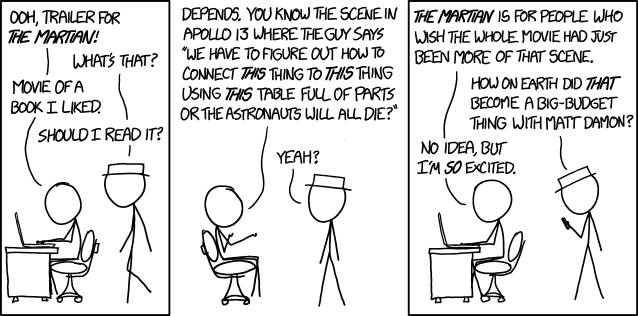
Since this book rekindled my interest in space travel, I recently watched (or re-watched) a few movies in the genre. Apollo 13 was an especially notable influence on this book, which is summarized in this xkcd strip:

 There is even a reference to a bit of dialogue from Ron Howard's film when someone in The Martian is referred to as "a steely-eyed missile man". To say any more would spoil an exciting plot development.

Like the comic character, I'm excited to see the movie adaptation, as The Martian was one of my favorite books I've read this year. The situation is unique, the protagonist is relatable, and the climax is a breathless page-turner.

For more about the author and his book, check out his website.

Friday, August 21, 2015

Penn & Teller on Broadway

I've admired magicians Penn and Teller for a number of years, from their appearances on talk shows, their own TV shows, and movies they produced, so I had always wanted to see them in their natural environment, at the theater named after them in Las Vegas. A few months ago I noticed they'd be doing a limited run on Broadway, and figured, "That's a much shorter distance to travel and will be unique from the Vegas show." As of August 16, P&T have left the Marquis Theater, so this review is written for posterity rather than a recommendation for something you can seek out.

Penn Jillette (the one who does all the speaking) explained that this show became a de facto celebration of the duo having performed together for 40 years, starting in August of 1975. Penn saw Teller performing a needle-and-thread-swallowing trick (which he performed for the Broadway audience of course) and immediately decided he had to work with this silent sleight-of-hand master. Penn and Teller share a disdain for those who profit from lying and fooling the vulnerable, and when performing magic the pair will always remind the audience that almost nothing they see is as it seems. I had seen a few of the tricks during their many television appearances, but seeing the illusions live in a theater is comparable to the difference between listening to an MP3 and going to a concert. Even when I know what they're about to do, hell if I know how they do it.

At the risk of giving away the game, I'd like to give a specific example. Liz and I arrived late to the show (due to poor planning on my part). As we were seated, Penn and Teller were in the middle of a trick where they make an audience member's phone appear inside a dead fish, within a box, in the back of the auditorium. I had just seen this trick on their CW show Penn & Teller: Fool Us, so I told Liz we could watch that part on Hulu to see the part of the routine we missed. Now, I had been certain that Teller was palming the phone and then pulling it out when he cut open the fish, but when we watched closely on the TV show, the plastic in which the phone was contained can be seen peeking out from the fish guts, so... there must be some other method used. These guys keep one guessing.

My favorite routine involved a man being chosen from his seat to use a camcorder on stage, the feed from which was shown on a large overhead screen. This was allegedly to demonstrate why Penn and Teller choose not to use displays throughout their act, saying they distract from what is actually happening on stage. Indeed, they made the trick occur very differently on the screen from what was seen on stage, and I'm pretty sure this could not have been replicated on a TV show. And even though Teller warned us (via written signs) that the trick we thought they were doing was not what they were really doing, the outcome was incredibly surprising.

Penn & Teller do the classic magic tricks like pulling a rabbit out a hat and sawing a woman in half, but with their patented style. They also have tricks involving items as diverse as a metal detector, joke books, and a length of polyester fabric, that I've never seen any other illusionist do. Their sense of humor and skepticism is unmatched in their field, and here's hoping they keep it up for decades to come.

Friday, June 26, 2015

Lamb by Christopher Moore

I decided to read this book for two reasons: (1) I tend to like a story told from a different perspective (like John Gardner's Grendel and Philippa Gregory's The Other Boleyn Girl) and this one is humorously told by Jesus' childhood friend who saw him as a man, not as a savior (author's notes). In other words, I like the narrator. And (2) it answers a question from one of my favorite movies, Dogma: "Jesus suddenly goes from age twelve to thirty ... Where are the volumes of text dealing with the missing eighteen years?"

I enjoyed this book. It reads, not surprisingly, like a memoir: the narrator (Levi bar Alphaeus who is called Biff) alternates between talking generally about what is happening (either in the present writing or in the past reflecting on or introducing a scene) or the actual happening. I found that the material handled really well; and it helps that Moore does not attack or question Christianity as a religion or Christ, he's just telling a story. I think that (making it seem like this could've really happened in this way) makes the story the most compelling.

I think with books that I don't like, or don't like as much, I have way more to say but with this book I'm pretty much done talking. I liked it and I think if the subject matter interests you and you have the time, you should read it.

Visit Christopher Moore's website for more information about the author and how to purchase his books.