Showing posts with label movie. Show all posts

Friday, March 6, 2015

Snowpiercer: Movie vs Book

In the midst such a harshly white winter, it seems like a good time to revisit one of the most talked about movies of last winter. No no, I don't mean Frozen. Snowpiercer is the rare post-apocalyptic action movie that does something original. It is pretty unusual, and occasionally over the top, but worth a look. Be warned, I discuss a few spoilers.

The only survivors of a new ice age are stuck on a very long train that continually circles the planet on a very long track, in the hope of someday finding livable land. The backstory of how an attempt to counteract global warming resulted in the world freezing is briefly summarized in a few words of text at the beginning, and delved into more during a classroom scene halfway through. I was glad they didn't tack on the opening and closing monologues that Harvey Weinstein wanted, as that would have patronized the audience too much.

Chris Evans plays the protagonist, Curtis, who has been living in the neglected tail section and makes his way forward through the train cars to confront the oppressors at the front. In contrast with Evans' more famous character Captain America, Curtis often insists that he is not a leader, but of course he proves otherwise. In order to get further in the train, Curtis rescues Namgoong, a security expert, from the prison section. Nam is played by Song Kang Ho, who had previously worked with director Joon-ho Bong on the Korean monster movie The Host. The most prominent antagonist, Mason, is played by a heavily uglified Tilda Swinton, in comical coke bottle glasses and buck teeth.

Curtis confronts the reality of the class inequality between the tail and the front cars of the train. While the tail section eats protein bars made of insects, further along are sustainable food supplies that would be plenty to be distributed. The tail section has cramped, filthy quarters while their counterparts live cleanly and comfortably.

I didn't notice during the credits for Snowpiercer that it was based on a graphic novel, but one of the benefits of working in a library is sometimes I notice books or media that I wouldn't have known existed. So one day a patron was checking out the two volumes of the English translation of Le Transperceneige, and having enjoyed the movie I wanted to check out its source material.  I came to realize the film only takes the basic framework of the book; the idea of the Snowpiercer on its neverending track, the class inequality throughout, and a leader who worships the perpetual motion engine that keeps the train moving. It doesn't use any of the same character names and tells an original story overall.

The first volume, written in 1982 by Jacques Lob and subtitled The Escape, tells a fairly straightforward story of a rebellious tail section inhabitant and his female companion. Proloff and Belleau have their heads shaved and are accused of spreading a virus to the rest of the train after leaving the tail section, but although they may be carriers, they show no symptoms. It's somewhat predictable when they fall in love. The main plot driver here is that the train is slowing down and the leaders plan to disconnect the tail section from the train, and don't want the inhabitants to know they don't plan to evacuate it first. Ultimately, Proloff is convinced to become the new caretaker of the engine for the rest of his life.

The second volume of Snowpiercer, The Explorers, was written by Benjamin Legrand between 1999 and 2000 after original writer Jacques Lob died. This part actually depicts the adventures of a second train on the same worldwide track, sometimes called the Icebreaker, but other times referred to as Snowpiercer 2. Clearly this would be the simplest model for making a sequel to the film, as there would be no obligation to use the same actors but there could still be a reference to Curtis having existed and the change he brought to the underprivileged. The leadership on the Icebreaker constantly conduct "braking tests" and keep the inhabitants fearful of a head on collision with the original Snowpiercer. It is later revealed that there is a personal aircraft on board that can scout ahead, and that there is a second engine that can pull the train in reverse, so the reality is there has never been danger of that collision. One part that was especially preposterous was a trek off the track over a frozen body of water, to seek the source of music that is heard on the radar. However I was impressed that this volume told such a different story using the same post-apocalyptic train premise.

One thing that made the graphic novel a little hard to get through was the style of the word balloons, which were all connected by white space so I was sometimes unsure which character was speaking. For all I know, this may be common in French comics. The fact that it's entirely black and white and often violent reminded me of The Walking Dead comics. The source material for Snowpiercer is definitely not essential for fans of the movie since the content is so different, but it was interesting to think about how the director used the premise and the themes to fuel his own vision.

Friday, February 13, 2015

Kingsman: The Secret Service

Kingsman: The Secret Service is a movie that delights in subverting your expectations at every turn. That subversion starts with the casting: Colin Firth plays a badass spy, Samuel L Jackson's character gets nauseous at the sight of violence, Marc Strong is helping the good guys, and Michael Caine... well to say anything about him would be saying too much.

According to Wikipedia, Kingsman is only loosely based on Mark Millar's comic (titled simply "The Secret Service) but his sensibility is all over it. Just like the last time Matthew Vaughn adapted a Millar story (2010's Kick-Ass) this movie would offend those with stomachs as weak as Sam Jackson's character, Richmond Valentine. There's a scene in a church that was especially hard to watch, even though the victims could be said to deserve it. Violence aside, the suggestion of kidnapped world leaders eventually agreeing with the motivation behind the villain's plan might be a shocking concept. It's even implied that our current president is involved, though we only see the back of his big-eared head. Apparently the original comic centered around the actual MI-6 agency, while the Kingsman service in the movie is funded independently from the government. This change might have been made to avoid litigation from Eon Productions, those behind the James Bond series. But they sure didn't have a problem pointing out within the script how similar all this is to that franchise.

This movie takes a lot of the familiarity of Bond movies and cranks up the edginess to the level of a well-deserved R-rating. While Bond's gunshots and fisticuffs are mostly bloodless, in Kingsman the violence is gory and in-your-face with its slick, stylish stuntwork. Where Bond would order his famous "vodka martini, shaken not stirred" the one martini order we hear from our protagonist is specified as "gin, not vodka, stirred for 10 seconds" and these gentleman spies largely prefer whiskey. And as for the point when Bond would intimately get to know one of his leading ladies after saving the world, let's just say Kingsman's leading man goes where no MI-6 agent has gone before. There are even moments when the hero and villain state what we think would usually happen in the given situation, but then remind us bluntly "This isn't that kind of movie." Well, it really isn't.

Kingsman borrows from movies other than the spy genre as well, but puts an original spin on the ideas. For instance, when the new recruits were being trained and whittled down, it kind of reminded me of Agent Jay's training in Men in Black, crossed with the culling of children in Willy Wonka and the Chocolate Factory. The tasks that Eggsy barely passes demonstrate that he's just the right misfit for the job. Though certain twists at the end of that sequence again subvert expectations.

I was impressed to learn Firth did 80% of his own stunts. He has stated that he was chosen for the role of Harry Hart mainly because of how unlikely he seemed for that type. Newcomer Taron Egerton (now that I think about his last name I wonder if it's the reason his character is nicknamed Eggsy) was perfect for the role of the trainee and I can see this being his breakout into a lot of work in the future. Caine, Strong, and Jackson were all excellent as always, and as I said they play parts we haven't seen them do before. And I can't forget to mention Mark Hamill's fun cameo, which I'm sure was created because Hamill himself is a character in the comic book, though in the movie he's a professor of a different name.

Kingsman: The Secret Service is a well-directed, original action flick that might occasionally make you cringe but will definitely keep you guessing. If you always wished James Bond didn't have to be so "PG-13" all the time, this might be the movie you've been wanting.

Check out the official site for more information and an interactive game, or Fandango for tickets.

Friday, January 2, 2015

The Interview

I saw The Interview in a movie theater, and I remain unharmed.

A few weeks ago, that seemed like it would be unlikely. At least the theatrical viewing. You probably know about how all of this went down, but let's consider the following a record for posterity:
The so-called Guardians of Peace, after hacking Sony Pictures' employees' emails in an attempt to get The Interview pulled from theaters, had threatened terrorist action referencing 9-11. This caused all the major theater chains to back out of playing it, which in turn caused Sony to pull it altogether. Later, independent theaters who remained determined to show The Interview were once again permitted to do so.

When tickets were made available by the Alamo Drafthouse chain, I bought tickets for my brother and I to see it on the day after Christmas at the Alamo location in Ashburn, VA. Not long after I made that purchase, it was announced that the movie would be available on Google Play, YouTube, Xbox Video, and a website made by Sony itself. Had I known about the online distribution, I could have saved a couple bucks and an hour-long drive. Nevertheless, we enjoyed our experience, and in a small way we stood up for our American right to free speech by watching a film where Seth Rogan and James Franco plot to assassinate the leader of North Korea.

The question that remains is, is this controversial movie even any good? If Sony had known the trouble it would cause them, would they have greenlit it in the first place?

To the first question, yes, I found it to be a very funny and sometimes thoughtful movie, but some of the raunchy humor and violence became gratuitous. Ever since Pineapple Express, Rogan and his writing/directing partner Evan Goldberg have been fascinated with having an ultraviolent climax to their action packed comedies. It's not the blood itself that bothers me, but the clash in tone; are we meant to laugh as a man gets his fingers bitten off, assuming that he's the equivalent of a cartoon character? Come to think of it, he didn't seem to be in much pain in the next scene so maybe that answers that.

These filmmakers are also fond of homoeroticism, sexual mishaps, and anal retention (I am not referring to attention to detail). These moments may bother some, but I thought they were handled in hilarious ways that made me shake my head with a chuckle. There is a funny cameo at the very beginning that will make you wonder "how the hell did they convince him to say that?"

I'm going to lightly spoil the movie, so skip the next paragraph if you plan to see it.

What would most upset the country of North Korea about The Interview is not the simple fact that the plot involves killing Kim Jong-un, but how the movie goes out of its way to make their revered leader look flawed and... human. And the ending depicts something happening that might actually occur in that country if its citizens realized that the Emperor (in one shot, quite literally) has No Clothes. It's not his death that ends up mattering, but the exposing of lies he and his allies have told the population in order to stay in power.

So it may be a dumb Rogan/Franco movie, but it also has something to say. It's not the greatest satire ever made, but if you can stomach the shock value, and/or you believe no art should be censored for political gain, it's worth checking out.

As stated above, you can watch The Interview at several places online, each charges $5.99:
http://www.theinterview-movie.com/
Or, find it in a theater near you. The Alamo Drafthouse played some decades-old Korean propaganda before the flick, as well as exclusive messages recorded for the chain by Seth Rogan and Evan Goldberg, so those were interesting features. Watch out for tigers.

EDIT: Of course now, you can just stream the darn thing on Netflix.

Friday, December 12, 2014

Looking for Bill Watterson

Most people who read newspaper comics in the late 80s through early 90s enjoyed Bill Watterson's incomparable Calvin and Hobbes. Others grew up reading the strip in collective book form. Despite the lack of merchandising or continuous syndication, the blond 6-year-old and his pet tiger have remained just as beloved and timeless as contemporaries like Peanuts and Garfield .

A documentary called Dear Mr. Watterson that started streaming on Netflix this year examines the legacy and influence of Watterson and his creation. Several comic strip writers, artists, and syndicate representatives are interviewed, some who were colleagues and some who are fans. Bill Watterson remains somewhat of an enigma since he has remained reclusive and has consistently refused to be an interview subject, so of course the documentary can't provide a lot of insight into what makes him tick. Nonetheless, director Joel Allen Schroeder made a worthy tribute to the artist.

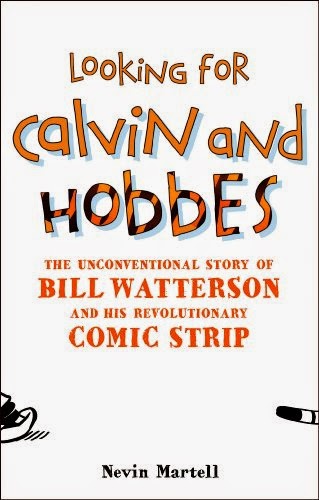
One of the people interviewed for the documentary was Nevin Martell, who is the author of a book called Looking for Calvin and Hobbes: The Unconventional Story of Bill Watterson and his Revolutionary Comic Strip. I found that a local library owned the book and I was pleased to discover that it made for an excellent complement to Dear Mr. Watterson.

Both the documentary and the book discuss how Watterson started as a political cartoonist and decided that wasn't for him. He always wanted to do something more imaginative and original. He based the town depicted in the comic strip somewhat on his hometown of Chagrin Falls, Ohio. He also wanted his art to speak for itself and always refused requests to merchandise the characters. He was especially incensed at the idea of making a plush Hobbes toy, because he wanted it to remain ambiguous whether Hobbes was purely the product of Calvin's imagination. To answer a common question, Watterson was nothing like the mischievous Calvin when he was growing up; he was a shy and obedient child. As an adult, even when his work was awarded, he shunned the spotlight and seldom showed up to accept those awards in person.

What I especially enjoyed about Martell's book was that he described his struggles to interview anyone close to Watterson and inevitable failure to sit down with the reclusive man himself. This provided kind of a look behind the curtain of the sometimes frustrating process of writing a biography. It was also neat to find out Watterson had spent some of his early years in my hometown of Alexandria, Virginia before his family moved to Pittsburgh and then Chagrin Falls.

It is difficult to objectively review these two projects, as I have always been a fan of Watterson's signature work, and they're preaching to the choir. Suffice it to say, I think every fan of Calvin and Hobbes would enjoy Dear Mr. Watterson, and for more detail about the creator, all should definitely read Looking for Calvin and Hobbes.

For more information about Dear Mr. Watterson or to purchase it, go to the official site, and if you subscribe to Netflix streaming, click here to watch it.

For more about Looking for Calvin and Hobbes or its author, go to his official site.

Friday, November 28, 2014

Interstellar

For those who have not seen the movie, this review contains spoilers so proceed with caution. My recommendation: go see it.

The Earth of Christopher Nolan's Interstellar looks like the dust bowl in the 1930s. The majority of the population has regressed to an agrarian society with no government or military. Everyone turning to farming is unsustainable because a blight is causing crop after crop to die out. At the opening of the movie, it seems only corn remains of all the crops we're used to consuming. The Earth is in the beginning stage of worldwide famine.

Our hero, Cooper (Matthew McConaughey), is a single dad and farmer trying to take care of his two children. His daughter, 10-year-old Murph, is troubled by a distortion in her bedroom where dust falls in a strange pattern. Cooper realizes they are coordinates and finds what remains of NASA. He is recruited to pilot a mission to find a new Earth. Years prior, scientists discovered a wormhole that allowed them to send probes to find a potential new Earth. Multiple scientists followed those probes, transmitted their findings back, leaving the team with three potential planets (referred to by the name of the scientist).

Cooper's father-in-law, Donald (John Lithgow), seems to represent people right now. For me, that connection made me able to relate to the film more than I would've otherwise. In the film, Donald talks about his youth and how there were innovations all the time (my mind went to the frequency of iPhone releases) and hot dogs at baseball games.

I liked the robots TARS and CASE. I thought it was clever that their personalities could be adjusted by percentage, such as 90% honesty and 75% humor. In the beginning, I admit I thought they would end up like the Alien androids and betray the humans. After seeing the whole movie, it is clear that would have generated excessive conflict.

The first planet the team visits has a time dilation which causes 7 years to pass on Earth for every hour they are on the planet ("Miller"). I immediately thought of the concepts introduced in the Ender Quartet prior to the discovery of instantaneous travel. Although in Orson Scott Card's world, the time dilation occurs during space travel as opposed to being on a planet influenced by a strong gravitational pull. It was a tragic moment for Cooper when he realizes that Murph has become his age in the time he was on that planet.

While visiting the next planet "Mann", the film provides an interesting case study of two characters who do "evil" for different reasons.
  • Back on Earth, Professor Brand (Michael Caine) reveals that he never thought they could save the people of Earth by figuring out how to launch a space station into space from Earth with the entire population on board (Plan A). He thought the only viable option were the frozen fertilized embryos to grow and start a new colony on the new planet (Plan B). This dooms the people remaining on Earth, but allows for the the continuation of the species.
  • On "Mann", Dr. Mann (Matt Damon) fabricated data to get them to rescue him because he did not want to die. All the other scientists that found planets that were not viable accepted their fate and went "quietly into the night" but Dr. Mann decided he did not want to die, and maybe wanted the glory of discovering humanity's salvation. This is just evil: selfish and unforgiving.
I liked this film. I did not like how it ended, but I understand why it did. Having Murph grow up to be the savior of the species because of the information Cooper was able to relay back to her was satisfying. The idea of Cooper seeing his daughter die of old age was a real bummer, especially since Murph wanted to be surrounded by her descendants and shooed him away (again, I understand why but I don't have to like it).

The part that I really didn't like was Cooper and TARS stealing a plane to get back to Brand (Anne Hathaway) and CASE on "Edmunds" where we see Brand burying Dr. Edmunds while setting up for the first colonists. Brand was in love with Edmunds so it's weird to me that he is dead and Cooper is expecting to arrive on "Edmunds" before Brand dies to confess his love. Or I could be wrong and he is going there to try to stop Brand from executing Plan B because she is unaware that Plan A is going to succeed. It is a very blah ending.